
Inside, Oceanview or Balcony: Which Cruise Cabin Is Right for You?
The best cruise cabin isn't always the most expensive one. Here's how to choose between inside, oceanview and balcony accommodations based on your itinerary, budget and the way you actually travel.
Eric Mallari12 min read
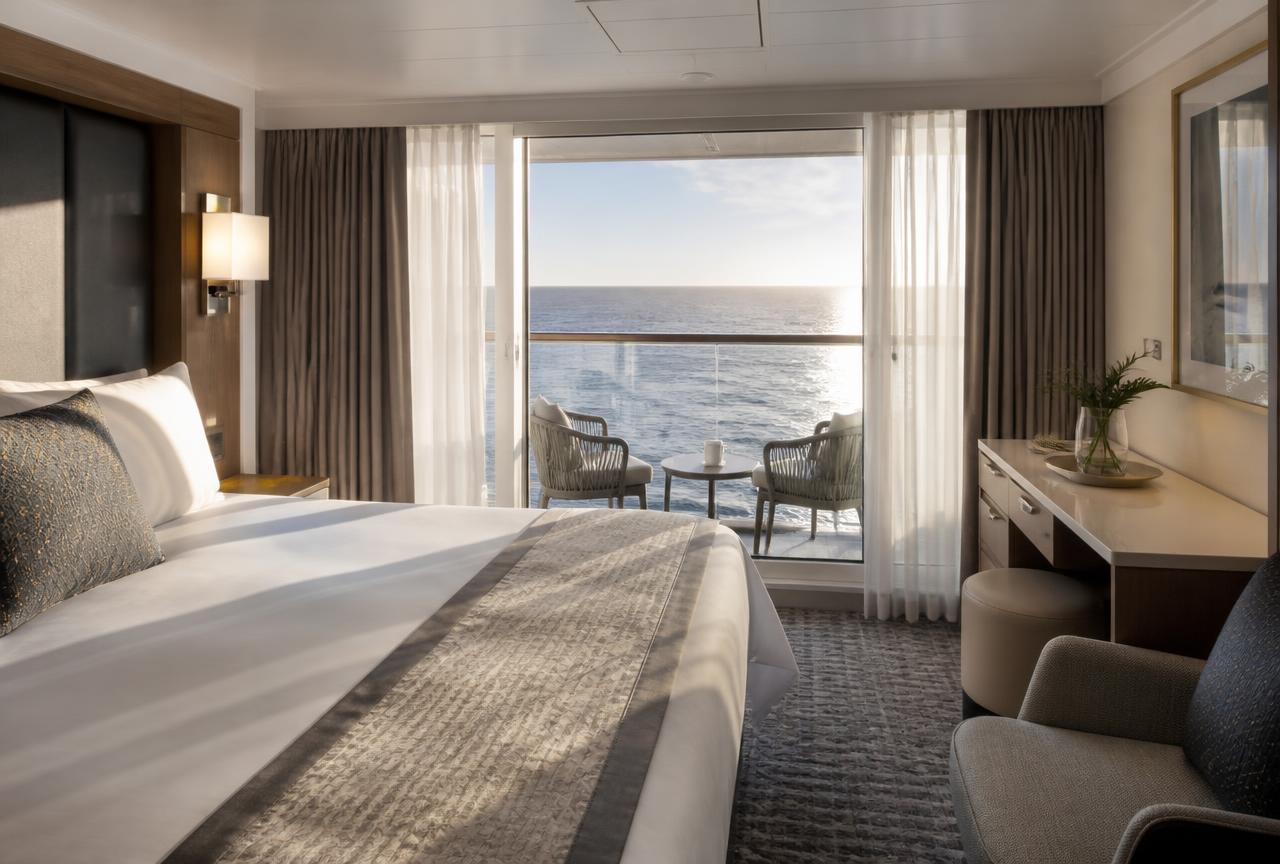
Choosing a cruise cabin is usually the first decision that makes a sailing feel real — and the first one that stalls people. The categories sound simple enough: inside, oceanview, balcony, suite. The difficulty is that the price gap between them can be several hundred to several thousand dollars, and nothing on a booking page tells you whether that gap is worth paying on your particular itinerary. The right answer depends on where you're sailing, how many sea days you have, what else you want your vacation budget to cover, and — most of all — how you actually use a cabin once you're on board.
Start with one question: how will you actually use your cabin?
Before comparing categories, be honest about your habits. Some travellers use the cabin for sleeping, showering and changing, and spend the rest of their waking hours ashore, at dinner, on deck or in a lounge. Others treat the cabin as a retreat — morning coffee before the ship wakes up, an afternoon of reading, a quiet hour away from the crowds, or simply somewhere to watch the water go by.
Those two travellers should not book the same room. The first is generally better served by putting the savings into the trip itself. The second is often genuinely happier paying for light, view or outdoor space, because they will use it every single day.
There is no wrong answer here, but there is a wrong process: choosing a category by prestige rather than by use.
Cruise Advisor Insight
The most common cabin regret I hear isn't 'I wish I'd spent less.' It's 'we paid for a balcony we barely sat on' — or 'we had six sea days and no natural light.' Both are use questions, not budget questions.
Inside cabins: spend less on the room, more on the trip
An inside (or interior) cabin has no exterior window. On most ships it is the lowest-priced category on board, and on many sailings it is the single biggest lever you have on total cost.
That makes inside cabins a strong choice on port-intensive itineraries, where you're off the ship early and back aboard in time for dinner. If your days are structured around shore time, the room is functionally a place to sleep — and the difference between an inside cabin and a balcony can be redirected into excursions, a pre-cruise hotel night, better flights or a specialty dining package.
There is a genuine comfort argument too: with no window, inside cabins are very dark. Light sleepers and travellers crossing several time zones often sleep noticeably better in them. The trade-off is real in the other direction as well — no natural light, no external reference point, and a more enclosed feel. Some travellers never notice. Others find it wearing by day four, particularly on itineraries with several sea days.
If you're weighing an inside cabin mainly to control the total number, it's worth understanding what is actually included in a cruise fare first, because the cabin is only one part of the final bill.
Oceanview cabins: the often-overlooked middle ground
An oceanview cabin has a window or porthole but no private outdoor space. It solves the main objection to an inside cabin — the absence of natural light and any sense of where you are — usually at a fraction of the balcony premium.
Oceanview gets overlooked for two reasons. Booking engines tend to push the visual appeal of balconies, and on some ships the oceanview inventory is small or concentrated on lower decks, so it simply appears less often in search results. That doesn't make it a lesser choice. For travellers who want to wake up to daylight and check the weather before dressing, but who realistically won't sit outside, oceanview is frequently the best value on the ship.
- Obstructed and partially obstructed views: Some oceanview cabins are priced lower because a lifeboat, tender, structural element or promenade sits in front of the window. The degree varies enormously — from a partial edge intrusion to a nearly blocked pane.
- Don't reject them automatically: Find out what is actually obstructing the view on that specific cabin and deck, then compare the saving. A lifeboat that covers the lower third of a window may be irrelevant to you; a fully blocked window is a different proposition.
- Window type matters: Depending on the ship, an 'oceanview' may be a large picture window or a small round porthole. Confirm which before booking, as the difference in feel is significant.
Balcony cabins: when is the upgrade really worth it?
A balcony gives you private outdoor space, and on the right sailing that changes the whole rhythm of the trip. Coffee outside before the ship wakes up. A quiet hour with a book while everyone else is at the pool. Sunsets without hunting for a deck chair. Scenic sailing watched from your own railing, and port arrivals and departures seen from the water rather than from a crowded rail. On sea-day-heavy itineraries, a balcony effectively adds a second room you can retreat to.
That's the honest case for a balcony. Here is the equally honest counterweight: none of it is automatically worth the price. The question is never 'is a balcony nice?' — it is: is the balcony worth the total additional cost on this particular cruise?
Calculate the full upgrade, not the per-night difference in the marketing copy. Multiply it out across the sailing, add the effect on taxes and gratuities where applicable, and then compare that number against what else it could buy: two or three excursions you'd otherwise skip, a pre-cruise hotel night that removes travel-day risk, upgraded flights, specialty dining, or simply a shorter gap before your next cruise.
It also helps to understand why the gap exists in the first place. Cabin category is one of the structural reasons one cruise costs $2,000 while another costs $20,000, and on some ships nearly all inventory is balcony or above, which changes the comparison entirely.
Weather deserves a mention too. On a cold-water or shoulder-season itinerary, a balcony may be used in short bursts rather than lounged on for hours — which is fine, as long as you priced it that way.
Match the cabin to the itinerary
Cabin choice should never be made independently of where you're sailing. The same category can be excellent value on one itinerary and hard to justify on another.
- Alaska — balcony value: very high: Scenery arrives constantly and often without warning: glaciers, wildlife, forested channels. Private outdoor space, ideally with a blanket and a hot drink, is used heavily here.
- Norwegian fjords and scenic Northern Europe — balcony value: very high: Much of the experience happens while the ship is moving, frequently in the early morning. A balcony turns transit time into the main event.
- Mediterranean — balcony value: moderate to high: The scenery is beautiful, but days are typically long and port-intensive, so you may be ashore during the hours you'd otherwise be on the balcony.
- Caribbean — balcony value: moderate: Highly dependent on price and the number of sea days. On a port-heavy week, an inside or oceanview cabin plus better shore planning often produces a better trip — see a calmer way to plan Caribbean port days.
- Transatlantic and sea-day-heavy sailings — balcony value: depends: With many consecutive days at sea, some travellers consider a balcony essential; others prefer a lower fare and spend those days in public rooms. Weather and season swing this one significantly.
Choose the cabin for the itinerary you booked, not for cruising in the abstract.
Cabin location can matter as much as cabin type
Two cabins in the same category on the same ship can deliver noticeably different experiences depending on where they sit. Location generally matters most for motion, noise and walking distance.
- Midship: Generally worth considering for travellers concerned about motion, since movement tends to be least pronounced near the centre of the ship, particularly on lower decks.
- Forward: Can experience more noticeable movement in rough conditions, and on some ships more wind or anchor noise. Often priced accordingly.
- Aft: Can provide attractive wake views and, on some ships, larger balconies — though vibration and noise characteristics vary by vessel and propulsion layout.
The five-minute deck plan check
Before confirming any cabin, open the deck plan and look at the space around it. This takes a few minutes and prevents most avoidable cabin complaints.
- What's directly above: A pool deck, buffet, fitness centre, nightclub or self-service laundry overhead can mean early-morning scraping chairs or late-night footsteps.
- What's directly below: A theatre, lounge or live-music venue underneath can carry bass through the floor into the evening.
- What's beside it: Crew access doors, service pantries and stairwells create traffic at unpredictable hours.
- Distance from elevators: Close is convenient and can be louder; far is quieter and can mean a long walk several times a day. Choose deliberately based on mobility and tolerance.
- Connecting doors: Useful for families, less so otherwise — connecting doors transmit more sound between rooms than a standard wall.
- Lifeboats and obstructions: Check whether anything sits in front of the window or balcony, and how much of the view it takes.
- Accessibility configurations: Accessible cabins have specific layouts and locations. If you need one, identify it on the plan rather than assuming availability.
- Proximity to what you'll use: If you plan to be in the spa, kids' club or main dining room daily, a few decks can make a meaningful difference over a week.
What is a guarantee cabin?
With a guarantee fare, you book a minimum category and the cruise line assigns the specific cabin later — sometimes well after booking, occasionally close to sailing. The potential benefit is price, and there is always the possibility of being assigned something better than the minimum you paid for.
The trade-off is control. You generally cannot choose the deck, position or specific cabin, and assignments are made to suit the line's inventory rather than your preferences.
Guarantee fares also tend to become more tempting as a sailing fills and named cabins thin out, which is really a timing question — our guide to how far in advance to book a cruise covers when choosing your own cabin is still realistic.
- Be cautious if you're motion-sensitive: You may be assigned forward or on a higher deck, which is exactly what a motion-sensitive traveller would normally avoid.
- Be cautious if you're a light sleeper: There is no way to check what sits above, below or beside the cabin until it is assigned.
- Avoid if you need an accessible cabin: Accessible requirements should be booked specifically and confirmed, not left to assignment.
- Avoid if you need connecting rooms: Group and family configurations depend on adjacency that a guarantee cannot promise.
- Reconsider if you have strong preferences: If a particular deck, a midship position, or a specific view or balcony type matters to you, pay for the certainty and choose the cabin.
Couples, families, solo travellers and accessibility
Who you're travelling with often decides the category before anything else does.
- Couples: A balcony frequently functions as additional living space rather than a view — somewhere one person can sit while the other sleeps or gets ready. That practical use is often what justifies the upgrade, more than the scenery does.
- Families: Configuration usually matters more than the view. Look at connecting cabins, maximum occupancy, bed and sofa-bed layouts, whether the bathroom is split, storage for a week of gear, and how far you are from the kids' club or pool. Larger groups should also read our guide to multi-generational cruising, where cabin layout and proximity drive most of the planning.
- Solo travellers: Where a ship offers dedicated solo accommodations, compare them properly against a standard cabin at the applicable single supplement. Judge the total price you will actually pay, not the advertised per-person fare, which generally assumes two people in the room.
- Accessibility: Confirm requirements before booking rather than after. Accessible cabin configurations, door widths, turning space, bathroom layouts and available categories vary by ship and cruise line, and accessible inventory is limited.
What about suites?
Suites are often presented as simply more square footage, but depending on the cruise line and ship they may include a broader package: priority embarkation, a dedicated concierge or butler service, access to private lounges, restaurants or sun decks, additional dining privileges, or included amenities that would otherwise be purchased separately.
That means a suite is not always the extravagance it looks like on a price list — and not always the value it looks like either. Compare the whole experience and what's bundled into it, rather than the floor plan alone.
Ontario Cruise Center cabin decision guide
Use this as a starting point, then check it against the specific ship and sailing.
| If this sounds like you | Start here |
|---|---|
| I want the lowest practical cruise fare | Interior |
| I want natural light without balcony pricing | Oceanview |
| I want private outdoor space | Balcony |
| I'm taking a highly scenic cruise | Balcony |
| My itinerary has lots of long port days | Interior or oceanview |
| I have several sea days | Balcony |
| I'm concerned about motion | Lower deck, closer to midship |
| I'm travelling with children | Family or connecting cabins |
| I'm travelling alone | Dedicated solo accommodations |
| I want more space and premium benefits | Suite |
| I don't care where my cabin is located | Consider a guarantee fare |
| I'm a light sleeper | Look for cabins above and below you |
So which cruise cabin is best?
There is no universal winner. An inside cabin on a port-intensive Mediterranean sailing can produce a better holiday than a balcony on the same ship, because the money went into the days ashore. A balcony in Alaska can be the single best line item on the invoice. Both can be right; neither is right by default.
The goal isn't to book the most impressive cabin you can afford. It's to work out where your vacation dollars will make the biggest difference to you — and then spend them there deliberately.
Because the best cruise cabin isn't necessarily the most expensive one. It's the one that fits how you want to experience the journey.
Compare My Cabin Options
Send me the sailing you're considering and I'll compare the available cabin categories, locations and upgrade costs to help you decide where your vacation budget makes the biggest difference.
Found this helpful? Share it with your travel crew
Related dispatches

How to choose the right deck on a European river ship
River ships are small, so deck choice changes your whole week. Here is how I weigh light, sightlines, stairs and budget before recommending a cabin.
Read Dispatch
7 min read
Why Does One Cruise Cost $2,000 While Another Costs $20,000?
Ship scale, service model, inclusions and itinerary explain most of the gap between a $2,000 cruise and a $20,000 one. Here is how to read the number before you book.
Read Dispatch
9 min read
How Far in Advance Should You Book a Cruise? A Complete Canadian Planning Guide
The best time to book a cruise depends far more on your itinerary and cabin needs than on chasing a last-minute deal. Here are the booking windows I use with Canadian travellers.
Read Dispatch
11 min read